Weekly Project: Have an Experience
Your project for this week is to have an experience. The parameters of the assignment will follow below. But first, let’s define an experience.
For the philosopher and psychologist John Dewey, “an experience” has an inner coherence that distinguishes it from a state of simply “experiencing things.” An experience has an inner structure, like a story; it has a meaning, even if that meaning is too complex to put into succinct words. An experience is characterized partly by struggle and effort, and partly by a surprise. An experience is an encounter between the world’s resistances–those sometimes inconvenient realities exterior to the self, those parts of the world that do not simply bend to our desires, fantasies, and perceptions–and the active, intentional work of the mind. Mind and world do not always connect, Dewey notes:
“To put one’s hand in the fire that consumes it is not necessarily to have an experience. The action and its consequence must be joined in perception This relationship is what gives meaning: to grasp it is the objective of all intelligence.” (208)
Many of our most potent memories of early childhood are of such experiences in which we find we suddenly grasp concretely the relationship between our actions and the outside world. As adults, our truest experiences may be subtler, or more complex, than those of the child who plays with fire–though they are no less important.
Another way of saying all this is to define experience as a balanced, structured relationship between doing and undergoing. For most of life, Dewey argues, we are either doing or undergoing. What do we mean by these terms?
Doing is making your intentions manifest. You run from one class to another; you submit that job application; you complete your your assignments efficiently, sometimes doing one as quickly as possible so as to leave time for the next. In its extreme or unbalanced forms, doing can erode experience and meaning: it can prevent that grasping which is, again, “the objective of all intelligence.” (208) You study for an exam, but your work is so rushed that the facts don’t form a meaningful story in your mind, and you forget many of the names and dates you learned as soon as the exam is over. In Dewey’s words:
“Zeal for doing, lust for action, leaves many a person, especially in this hurried and impatient human environment in which we live, with experience of an almost incredible paucity, all on the surface. No one experience has a chance to complete itself because something else is entered upon so speedily. What is called experience becomes so dispersed and miscellaneous as hardly to deserve the name. Resistance is treated as an obstruction to be beaten down, not as an invitation to reflection. An individual comes to seek, unconsciously even more than by deliberate choice, situations in which he can do the most things in the shortest time.” (208-209)
Sound familiar? It should! The pressures of student life in an environment characterized by intense competition, political instability, uncertain economic prospects, and engagement in an excess of non-study activities (working to pay the rent, developing your career resumé) creates a situation which encourages us to treat, at times, those opportunities designed to provide an educational experience as mere acts of doing.
Resistances are aspects of the external world that do not conform to our will or expectation. Sometimes we must beat down the world’s resistances: Imagine you are sitting an exam in which you must draw a diagram, and your pen breaks starts to bleed ink everywhere. The world’s resistance has gotten in the way of your doing something important! You are forced to either fix the pen or find a new one, but the resistance is, again, “an obstruction to be beaten down” and not “an invitation to reflection.” (209)
If you are using the same broken pen, however, to make an abstract drawing, for your own enjoyment and self-expression, this resistance might offer you an opportunity to draw differently: to play with smudges and smears and beads of goopy ink.
The fact that our lives have trained us to treat resistances as obstacles, rather than opportunities for reflection, sometimes prevents us from seeing opportunities for reflection or creative action–even in situations in which we are permitted or required to act with creativity. (When someone tells you to “just be creative,” and you find yourself at a loss, what you are feeling may be a lack of resistances. This is why creative assignments have strictures and guidelines! It’s harder, sometimes, to start from scratch.)
Undergoing is passive receptivity. When you merely undergo experiences, you are the passive recipient of things outside yourself: you look out the window of the bus; your mind drifts; you think of this and that but do not have any revelations, any mental or emotional breakthroughs, for your mind is not engaged in an active struggle to bring any of these ideas to a conclusion or to a new level of complexity. Because you are not focused on doing, you do not experience the world’s resistances so forcefully; in undergoing, resistances are not to be overcome so much as avoided or ignored. Some of our entertainments–watching fun, “easy” movies or television, scrolling passively through Instagram–are forms of mere undergoing. But an “excess of receptivity” can–like an excess of doing–arrest the course of true experience, can “cut [it] short from maturing.” Dewey writes:
“What is prized is then the mere undergoing of this and that, irrespective of perception of any meaning. The crowding together of as many impressions as possible is thought to be ‘life,’ even though no one of them is more than a flitting and a sipping. The sentimentalist and the daydreamer may have more fancies and impressions pass through their consciousness than has the man who is animated by lust for action. But his experience is equally distorted, because nothing takes root in mind when there is no balance between doing and receiving.” (209)
Less pessimistically, you might think of undergoing as the mind’s state of being at rest, at leisure. In this state you are neither acting on your intentions nor attending to or absorbing the full otherness of the world outside yourself. Undergoing is often enjoyable and counteracts an excess of doing. Dewey says the human personality and intellect requires a healthy balance of doing and undergoing. More than that a certain dynamic relationship between the two states is what characterizes an experience.
An experience brings together doing and undergoing. Consider the artist at work: she encounters limitations or resistances in her materials, then incorporates those resistances into the work. Moreover, she encounters the results of her own doing as external facts she must undergo: “Each resting place in experience is an undergoing in which is absorbed and taken home the consequences of prior doing.” You draw a line; its shape surprises you, but you embrace the surprise and change your plan to incorporate it.
Or consider a real educational experience: you finish a particularly challenging mathematical proof without any help; you feel the seemingly arbitrary names and dates you memorized for your history class click together into a story, an explanation; you start out hating a particular type of method or problem set, but it gradually becomes your favorite; you find that the four seemingly unrelated classes you registered for this quarter are somehow a conversation with one another, inside in your mind, when you least expect it. Or you are asked to look at a painting, sculpture, or poem where initially nothing of interest seems to be there–but you look harder, look again; you undergo it, and struggle to make it mean something.
Consider, finally, by contrast, those moments of disappointment when doing and undergoing fail to coalesce into an experience. A much anticipated vacation, say, might have an underlayer disappointment to it. You may have a zeal for doing as you check sites and experiences off your checklist, while at the same time feel that you are merely undergoing “this and that,” that you are the passive recipient of “the crowding together of as many impressions as possible.” (209) It may be only later–after you return, after you have had time to absorb and think–that all this doing and undergoing coalesces into meaning. Perhaps only later will the trip feel like “an experience,” whether you recall it as a positive or negative one. Or it may never mean much at all. That’s life.
The Assignment
Choose one of the following experiences: bird-noticing or close looking. Notice that these are all variations of the type of exercise in attention that Jenny Odell describes in How to Do Nothing. Take at least one photo during your experience. Upload your photo and a 300-500 word reflection. Cover the following questions:
– Why did you choose your experience? How did you start?
– What were the challenges you encountered? The struggles? The resistances?
– Which aspects of your experience involved “doing,” and which involved “undergoing?” How did each feel? How do these aspects of experience interact? You could describe doing and undergoing as emotions, or types of cognition, or sensations, or textures.
– Did you encounter that type of resistance called boredom? What did you do with that feeling? If and when you were bored, what kinds of new things did you find to notice?
– What other kinds of resistances did you encounter? Things you couldn’t perceive, discern, figure out, or understand?
Option One: Bird-watching (or, as Jenny Odell calls it, bird-noticing)
Spend at least one hour outdoors at an area birds frequent. Set a timer.
Spend 20-30 minutes of your time learning to identify some birds. Try to find at least two species that you don’t know already. You may download and use the Cornell University Ornithology Lab’s MerlinID app–it’s free! (Recall Odell’s observation that “there are forms of technology” that “might situate us more fully in the present.”)
Avoid using your phone for any activities that are not directly related to bird-watching.
Spend the rest of the time observing birds. Try to find one bird that you can observe from a reasonable distance without scaring it into flying away from you. Spend as long as you can observing just this one bird. (Recall Odell’s use of Emily Dickinson’s poem, A Bird, came down the Walk.)
Many birds are more active early in the morning (in the two hours after sunrise) and around dusk (the two hours before sunset), but local birds such as crows, juncos, and waterfowl are active all day.
Some good places on or near campus include:
* The Medicinal Herbs Garden (between the Biology and Chemistry buildings)
* The Grieg Garden (by Allen North)
* Union Bay Natural Area, behind the IMA (this is the best one; eagles roost in an area near the stadium-side parking lot)
* UW Arboretum, Ravenna Park, Discovery Park, Seward Park, Volunteer Park!
Option Two: Close Looking (at things meant to be looked at, and closely)
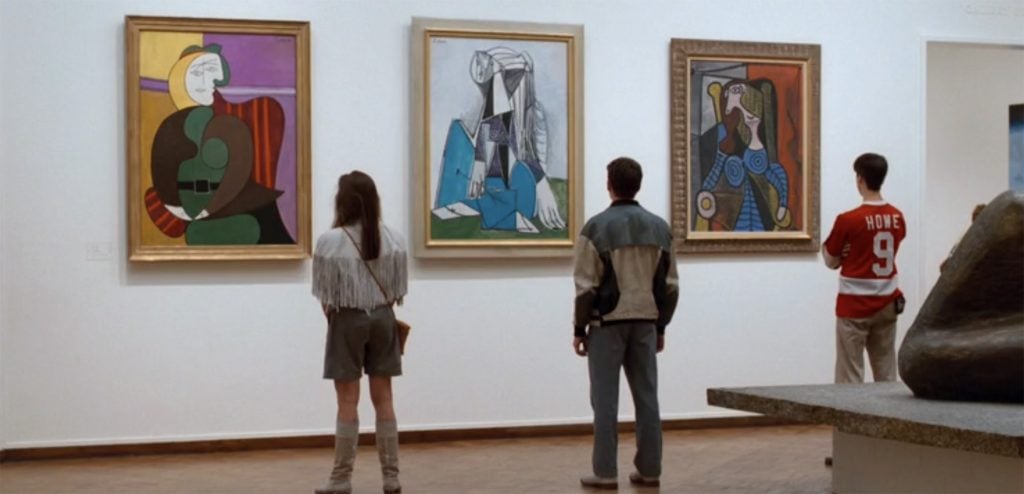
Go to an art museum in person and spend 20 minutes looking at one single painting or work of sculpture.
The trip will also likely take you an hour, as you will need to wander through the museum and choose your artwork. Don’t overthink your choice. You could potentially choose a work of art at random. Make sure it is not a video or interactive piece: it should hold still before your eyes. A painting, sculpture, textile, photograph, or print is ideal. Make sure you have a place to comfortably stand or sit for your 20-minute period of observation.
Set a timer for 20 minutes, silence your notifications, and do not use your phone at all during that period. Do not give your attention to any of the other artworks in the room with you. Spend the full 20 minutes fully engaged with one, single artwork.
You may walk around the piece, peer at it from close up, stand back and gaze at it from afar, approach it from different angles, and so on. If you find yourself in a conversation with a museum worker or another museum patron, focus it on the piece–and if if you talk for more than a few minutes, add some time to your timer. Make the majority of your 20 minutes a time of quiet contemplation. By looking quietly, and alone, you are forced to keep returning your attention to the object, to again and again find something new. You will observe things that are foreign to your thinking, your self, your imagination, then attempt to make meaning of them.
You may spend as much time as you want after your 20-minute observation looking up the artist or the artwork on your phone or computer, reading about the work, etc., but I highly recommend leaving this for after your period of close looking.
Options for museums to visit:
The Henry Art Gallery (Free)
Right on the UW Campus!
Mon–Wed: Closed
Thurs: 10 AM – 7 PM
Fri–Sun: 10 AM – 5 PM
Frye Art Museum (Free)
First Hill, accessible by many bus lines
Mon–Tues: Closed
Wed: 10 AM – 5 PM
Thurs: 10 AM – 8 PM
Fri–Sun: 10 AM – 5 PM
Seattle Art Museum ($22 for students / learn about further discounts)
Downtown Seattle, by Symphony light rail stop
Mon–Tues: Closed
Wed: 10 AM – 5 PM
Thurs: 10 AM – 8 PM
Fri–Sun: 10 AM – 5 PM
The Seattle Asian Art Museum (“Pay What You Wish” admission. You could pay a penny, like I always did in college!)
In the middle of Volunteer Park
Mon–Tues: Closed
Wed–Sun: 10 AM – 5 PM
Due to museum schedules and this week’s in-class essay, you have an extra week to do this assignment. Both this and your next week’s assignment will be due on Tuesday, November 18th at 11:59 PM.