Weekly Project: Tool, Purpose, Use
Next week, we will be moving from our discussions of techniques and technologies of knowledge to the development of more concrete artifacts: tools. To prepare for this shift, I am asking you to do a very short, easy, simple exercise that should take no longer than 15 minutes.
THE PROJECT: NAME A TOOL, ITS PURPOSE, AND SOME OF ITS OTHER POSSIBLE USES
1. Choose something that you consider to be a tool. This can be a simple hand tool or household implement. If you have a hobby such as sewing or woodworking, you could a tool related to your hobby. Make sure you choose a tool you have used before. Name the tool, and if it is something we might not be aware of, you can offer a link or include a picture.
2. In one or two sentences, state as simply as possible what the tool’s intended use is.
3. List five other ways of using the tool that most people would not consider to be related to its “main” function as defined in #2.
4. Follow the rules listed in below in the section called, “important rules!”
That’s it! To show you how it’s done and offer inspiration, here’s an example of what we will consider good work on this project:
EXAMPLE: Weekly Project on Tool, Purpose, and Use: Pencil
The tool is a wooden pencil. This kind of pencil: the yellow kind that isn’t perfectly round but has flat sides so that it won’t roll away.
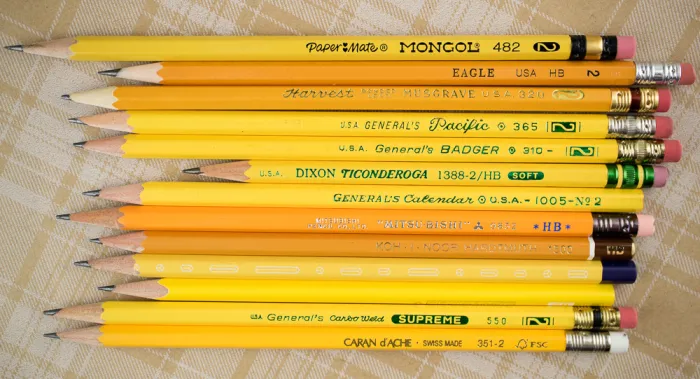
The purpose: A pencil is used for writing and drawing, usually on paper. Most have erasers which can also erase pencil marks.
Other uses for a pencil:
1. You can use the tip to puncture the plastic shrink wrap type of packaging, so that it’s easier to tear off
2. You can use it to hold your hair in a bun (if you have long hair)
3. Self-defense (in a pinch)
4. If you have a lot of string or ribbon, or a lot of rubber bands, you can use it as a spool to wrap that around for storage
5. If you have a LOT of pencils you can build a little house with them, like with Lincoln Logs. (This only works with pencils that have the flat sides, so that they don’t roll away).
Boom! Done. No need to offer any additional notes or reflection. If you have ideas you really want to share, don’t hold back, but extra length won’t influence your grade. I only offer my own reflections because I think they might help you.
My own reflections: Thinking of three things was really easy. The first two are things I do with pencils all the time, and the third felt like a variation on #1. (I expect that many objects could be used for “self defense,” given the right circumstances.)
Thinking of two more things was surprisingly hard. I almost immediately felt stuck, and was tempted to Google around for inspiration. But I didn’t. Instead, I just jotted down the three ideas, then went outside, had a meeting, did some other work, then came back and completed the list. I thought of other possible uses while I was walking around. I still felt at a loss, but then let myself thing of ideas that sounded… both kind of goofy, and kind of boring. That’s actually the kind of thing we are looking for: you discover more about objects that way!
For instance, when I thought of stacking pencils to make a little house, I realized that the kinds of pencils I was thinking of weren’t fully round but were, rather, hexagonal–they have flat sides so they won’t roll away. So I went up to the object description and specified that I was thinking of the pencils with the flat sides, specifically. I wouldn’t have really thought of that if I’d come up with a more sophisticated, cooler option for #5.
You are allowed to add details as you go, but keep your descriptions short and simple.
Important Rules!!!
1. Don’t use the internet for this project. That is, do not use ChatGPT, Claude, or any other AI-related tool to get ideas for your list of uses. Do not even Google “uses for this tool” and find examples from WikiHow or any other content mill. It’s tempting. I was (see above) tempted when I tried it myself! But It would probably take more time and effort to scour the internet for ideas than to just use your head, and a part of the fun of this is trying to come up with a list of uses as quickly as possible, failing, then thinking of something weird.
2. Keep it PG-13. Don’t do anything with your tools that you wouldn’t joke about with a 13-year old. That’s fairly broad license already.
3. There is no minimum or maximum word count as long as you offer a tool, its purpose, and five other uses. Have fun!
Due by 11:59 PM on Tuesday, October 21 in your Google Drive folder