Our Course Reader
Most of our assigned readings are a part of a reader designed especially for this course. For most students, this reader is only available in paper, hard copy form.
The texts in this reader have been selected and often heavily abridged by me (Mal), and I have written short introductions to each piece. My introductions give some historical context and often explain why I have chosen this reading and where it fits into the big ideas in the course. Curious onlookers may browse the reader’s front matter below:
Why a paper course reader? What year is this, anyway?
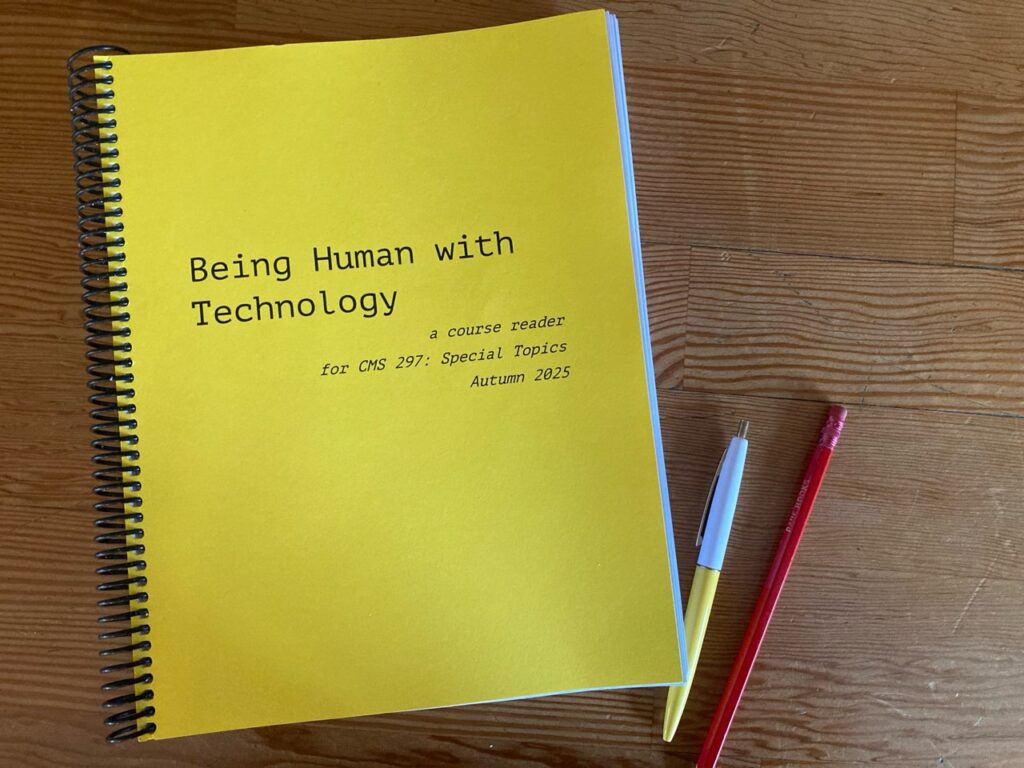
This course is partly how our tools affect our experience of the world. For the past 15 years, most college students (and professors) have used PDFs and other digital texts as their primary mode of completing assigned readings. A part of the goal of using a paper reader is to offer you an experience of course reading that may be less typical.
Moreover, numerous studies suggest that, for most of us, reading on paper is better for concentration and long-term memory. An article from Scientific American offers one theory as to why:
“When we read, we construct a mental representation of the text in which meaning is anchored to structure. The exact nature of such representations remains unclear, but they are likely similar to the mental maps we create of terrain–such as mountains and trails–and of man-made physical spaces, such as apartments and offices. Both anecdotally and in published studies, people report that when trying to locate a particular piece of written information they often remember where in the text it appeared. […]
“In most cases, paper books have more obvious topography than onscreen text. An open paperback presents a reader with two clearly defined domains–the left and right pages–and a total of eight corners with which to orient oneself. A reader can focus on a single page of a paper book without losing sight of the whole text: one can see where the book begins and ends and where one page is in relation to those borders. One can even feel the thickness of the pages read in one hand and pages to be read in the other. Turning the pages of a paper book is like leaving one footprint after another on the trail—-there’s a rhythm to it and a visible record of how far one has traveled. All these features not only make text in a paper book easily navigable, they also make it easier to form a coherent mental map of the text.” [source]
We encourage you to bring your paper reader to class on a daily basis so you can consult the text, take notes, highlight, doodle, dog-ear, and in all sense of the term make the maximum use of your reader. Finally, your reader will be the one thing you can have during your in-class essays, so we encourage you to use it!
What are we reading, and when?
Check the Class Schedule to see which readings are assigned for which session.
Where do I get my copy?
Paper course reader available for purchase at
Professional Copy ‘n’ Print
4200 University Way NE (Corner of the Ave and 42nd, between Magus Books and Bulldog News)
The cost is $39 plus tax. If this is a hardship, know that we have set aside some free copies for students who need them. Ask for one and you shall receive–no questions asked. 🙂