Weekly Project: Write an Origin Myth
The story of Prometheus is a formative myth in modern, Western narratives about technology. According to tales repeated in Hesiod, Plato, and Aeschylus, Prometheus the Titan stole fire from the Olympian gods to give it to humans, his favorite of Earth’s creatures.
In some legends, Prometheus’s gift of fire represents the very idea of technology, in its most general sense: according to Aeschylus, Prometheus gave humans the art of writing and the concept of number, without which neither the arts nor the sciences could exist.
Promethean technology transformed humans from the weakest of the animals–those animals without fur or claws or instincts, those who were, amongst all living creatures, the most vulnerable to nature’s forces–to the animals most capable of “mastering” nature.
But, according to the Promethean myth, humans obtained fire only at great cost. To punish Prometheus, Zeus sent humans Pandora, a synthetic female figure whose curiosity unleashed forces such as war and pestilence upon humans. In his turn, Prometheus was condemned by Zeus to be tied up on a high mountaintop and to have his liver torn out again and again by an eagle. For details on the tale of Prometheus, see Yuk Hui on “Cosmotechnics” (pages 270-271 of our course reader). The social outcome of the Promethean myth is also well captured by Pfaffenberger on “The Standard View of Technology” (pages 27-28 of our course reader).
Your assignment this week is to write your own, alternative myth explaining the origins of technology: how, you should ask yourself, did humans obtain the power of fire? Of illusion? Of mechanics? Of labor-saving techniques? Or of technology generally?
Your story can have optimistic or pessimistic implications. It can express your ambivalence about technology. Or your optimism, or pessimism, or whatever affect you happen to have. You may make up your own characters, your own supernatural forces, your own triumphs and tragedies. You may draw on any cultural, historical, religious, or mythological traditions you like–as long as you put your own spin on these tales and are able to explain your inspirations and your own contributions. A section on sources of inspiration follows below.
Your words must be your own. You cannot use ChatGPT, Claude, Copilot, Gemini, or any other LLM for this assignment. This means in any way. Do not use AI to “brainstorm” or “bounce ideas around.” Just don’t. Don’t do it! It’s easy. If you need to brainstorm:
* talk to a friend
* chat with your learning group
* use your brain
* look at the inspiration and guidelines below
* Remember:
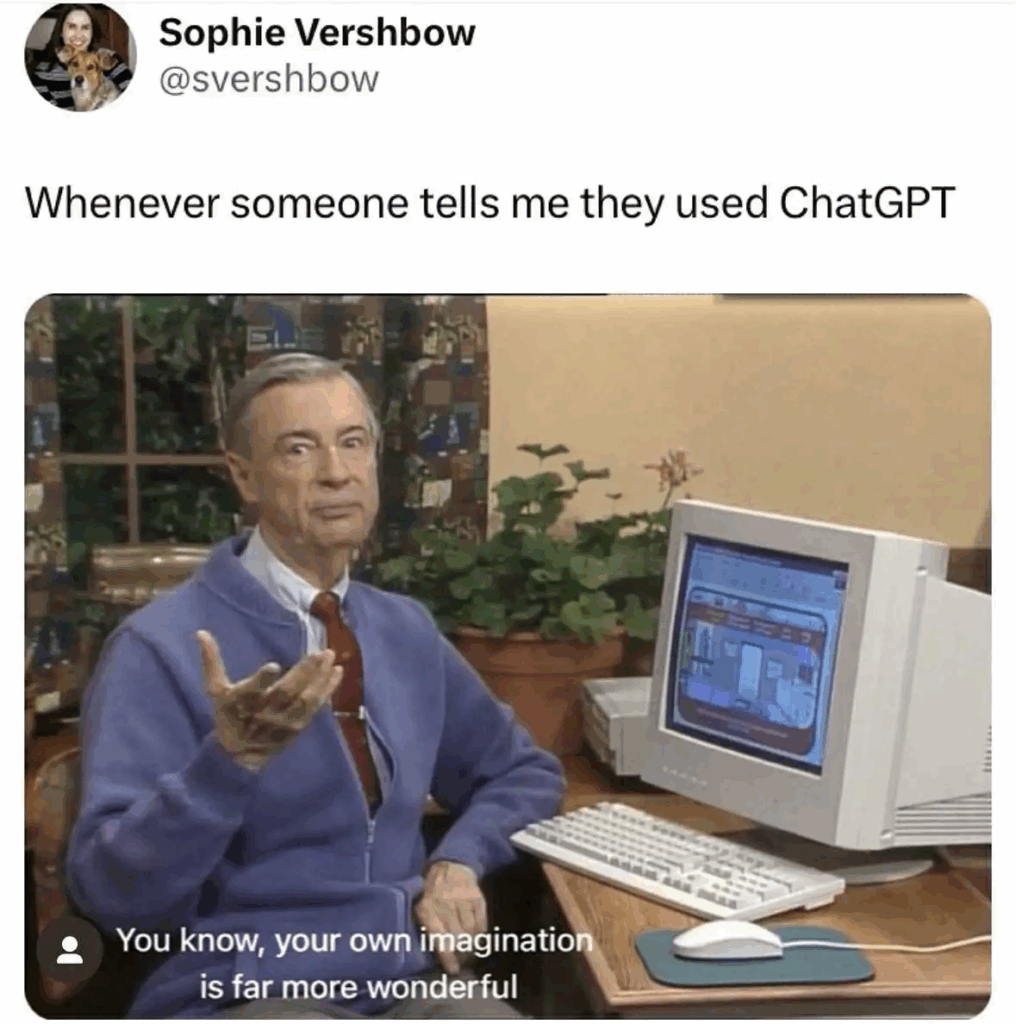
If we suspect you have used AI, your work will be sent to the Office of Community Standards and Student Conduct for review. If we confirm it, you will fail the assignment and be reported to the OCSSC. Use of AI is unequivocally forbidden on this assignment and most others for this course. Even if AI-enabled work slips past us, you are likely to do worse on this assignment because in most cases humans produce weirder and more interesting content, and even “bad” student writing is more fruitful and interesting to us than LLM stuff. So: just don’t do it.
What to do instead:
Create your Google Drive folder (see this Canvas link for details) and create a document with the title “Weekly Project: Write an Origin Myth” and whatever additional information you want in the title line.
Write your myth as a narrative of roughly 250-500 words. Longer or shorter is better, but remember that shorter works should feel complete in terms of narrative. You may also create a drawing or create a graphic narrative (such as a comic) for your myth. For a comic, you can restrict your words to far fewer, but submit 1-2 full pages.
Write a process note of at least 150 words stating:
– Any myths, stories, or historical incident you drew inspiration from
– Where your own narrative differs from the above, and why
– What you were trying to do in this work.
How it’s graded:
We are not grading you on your literary talent. If you really feel your story is not creative, explain in your process note what you wish you could capture or accomplish. (Note that your explanation may give you ideas for your narrative.) Refer to the Truth About Grades document for more information.
SOURCES OF INSPIRATION:
Assigned texts:
– Lewis Mumford proposes that it is Orpheus, rather than Prometheus, who should be taken to be the classical figure representing human ingenuity. See pages 246-247 in our reader.
– Yuk Hui offers several Chinese myths regarding the origins of writing, cooking and other arts in his essay on “Cosmotechnics,” pages 271-272 in our course reader.
– The sci-fi writer Ursula K. Le Guin wrote a short essay, “The Carrier Bag Theory of Fiction” (pages 319-323 of our course reader) that imagines the origin of fiction as related to the act of gathering (work that is easily done by the young, the elderly, mothers, and people who simply don’t move fast) rather than the heroic (and, in some accounts, canonically male) act of hunting.
– The philosopher of science Donna Haraway argues that the cyborg could offer an “ironic myth” of the origins of humankind that could dispel the idea that there was a “natural” human before technology, and argues that we should draw on science fiction (she references Blade Runner, Octavia Butler, and Joanna Russ) to build these mythologies.
Other texts:
– Prometheus on Wikipedia: A lot of sources for the Prometheus myth are gathered here. I am not a specialist in this area, so take it all with a grain of salt and check sources!
– Orpheus on Wikipedia: Orpheus was a poet who traveled into the underworld to rescue his wife, Eurydice. Some details on the story and sources can be found here.
– “Fire on the Land: Native People and Fire in the North Rockies:” For a more living and (relatively!) local perspective on the history of humans and fire, check out this website from the Salish and Kootenai Tribes (Eastern Washington) on fire stories and fire management.
How to submit it:
Upload to Canvas by the beginning of class on Tuesday, or bring a printed or hand-written copy to class and turn into your TA.